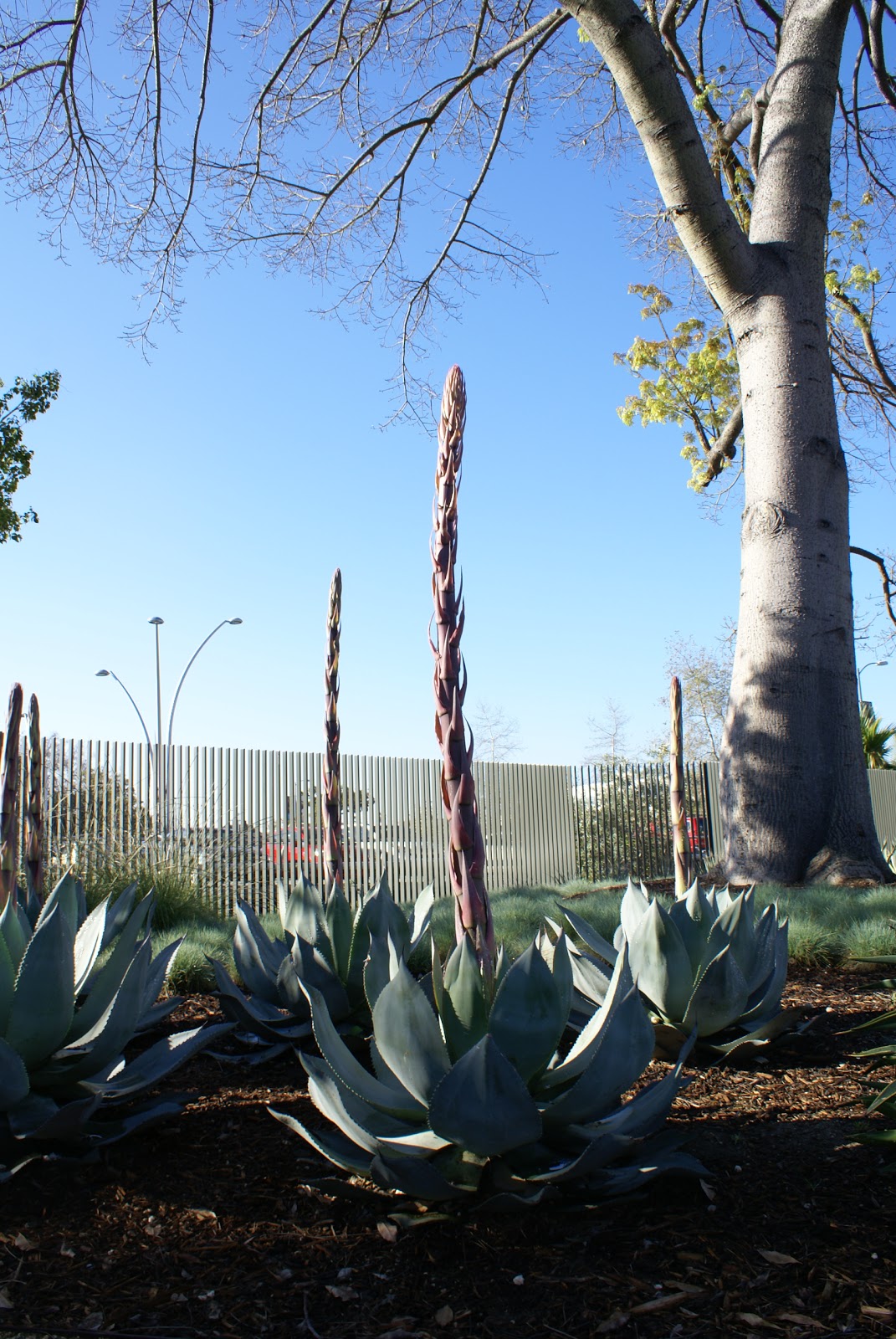
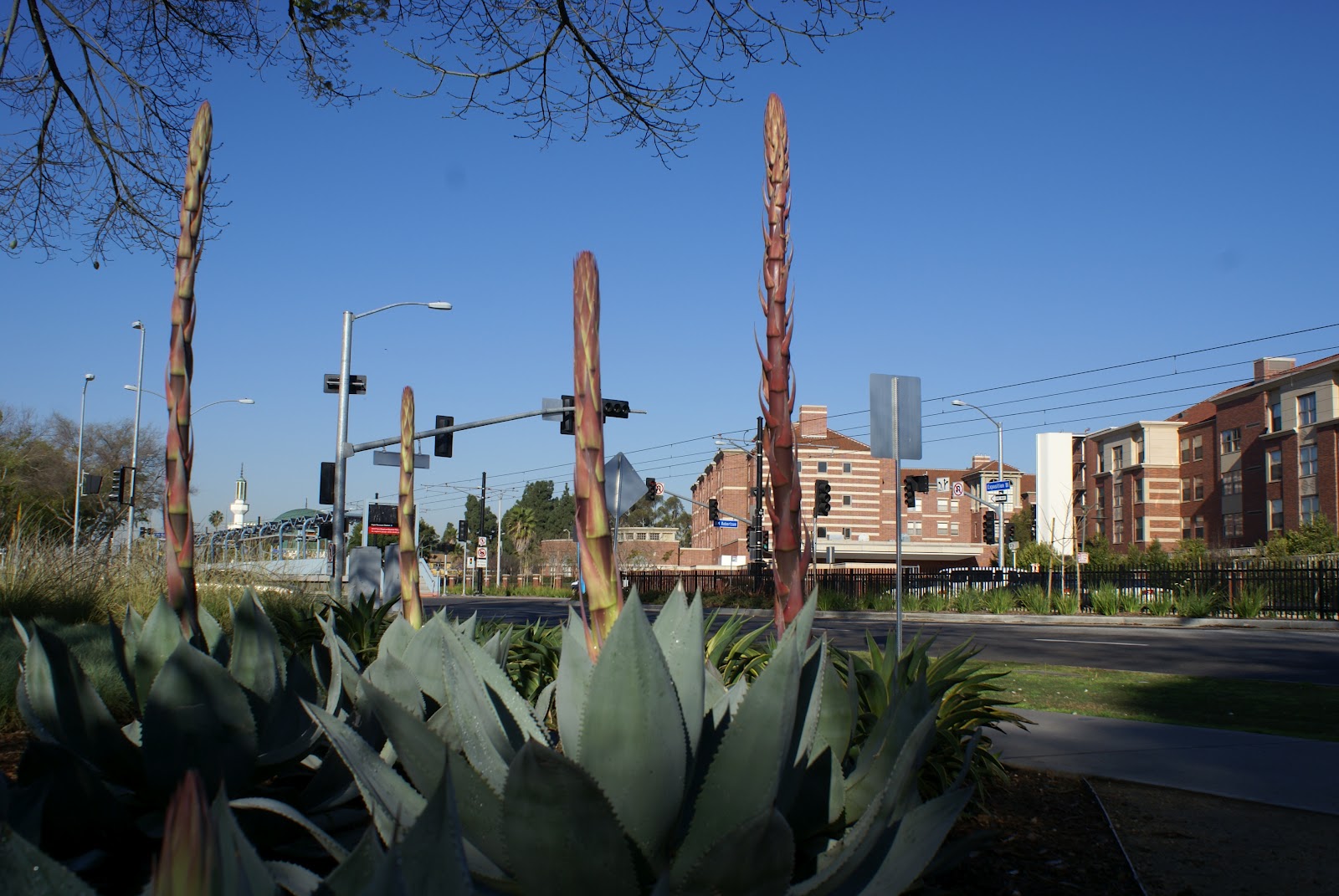
More plant news from the North Campus. Recently some of our blue lotus agaves,
Agave ceslii 'Nova', have begun to bloom. This is an impressive sight as these plants send forth long spikes, (between four and six feet long), that look a lot like giant asparagus stalks. This type of agave is monocarpic, meaning that it only flowers once, and this particular selection happens to flower at a relatively young age compared to other species. Incidentally, the genus is commonly called century plant because it can take decades for them to flower. The entire stand of this agave (approximately eight plants) is flowering at the same time, because they were all propagated from the same tissue culture, which is a common nursery practice for certain landscape plants. Although flowering signals the end of the plant's lifespan, we can expect to enjoy the flowers and fruits for the next several months!
Agaves reaching up to the floss silk tree
There are over 300 species of agave in the world, with 100 species native to North America. This large array of species includes well known agaves such as the tequila or blue agave,
Agave tequilana, and the sisal or hemp agave,
A. sisalana. Other species are also farmed to produce agave nectar, which is sweeter than sugar and honey.
The blue lotus agaves we have planted are native to Mexico and are becoming more common in the nursery trade. As with all agaves, the flower stalks possess literally hundreds if not thousands of individual blossoms, which are visited by many kinds of pollinators. The flowers will be a pale yellow color and will hopefully attract the numerous Anna's and Allen's hummingbirds that are already resident in Exposition Park. Unlike other agave species, the ones planted on the North Campus will not attract mammalian nocturnal pollinators, aka bats, which is a shame since we will be very soon putting up a bat box (more on that to come later)!
Four stately stalks!
Stop by the North Campus and check them out today! They are close to the Dueling Dinos on the North side of the Car Pak along Exposition Boulevard.