THIS BLOG HAS MOVED

This blog has moved it can be viewed here!

Showing posts with label Kimball Garrett. Show all posts

Tuesday, November 20, 2012

Thanksgiving for the Butter-butt (but not the Butterballs)!

Hold your horses...give me a moment to clarify this title, I'm talking about birds here! When I say "butter-butt" I'm actually referring to a small grey songbird that has a bright yellow patch on its derrière (yes, this really is what dorky birders like myself call this bird when we're out birding). In particular, I'm talking about the below pictured butter-butt, that narrowly escaped death hence the giving of thanks. In contrast, all those Butterball turkeys won't be giving much thanks. But hey, maybe you'll be inclined to give some on their behalf!
If this bird had a speech bubble, what would it be saying?

This is what Museum bird expert, Kimball Garrett, has to say about butter-butts, a.k.a. Yellow-rumped warblers:

"There’s hardly a surer sign of the approach of winter in the Los Angeles Region than the arrival en masse of Yellow-rumped Warblers (Setophaga coronata) throughout our lowlands in October. These hyperactive 12 gram songbirds breed widely in conifer forests of North America, and migrate in immense numbers to the southern United States (with some continuing as far south as Central America). In our area birds of the western 'Audubon’s' subspecies predominate. One secret to the success of this species is its generalized diet. Our fall and winter birds glean insects from vegetation or the ground, but also sally into the air to catch flying insects; they’ll also take nectar from a variety of flowers (winter-flowering eucalypts are especially preferred) and take their share of small berries as well. You’ll recognize Yellow-rumped Warblers by the eponymous color patch, as well as other yellow patches on the throat, the sides, and (usually hidden) the center of the crown, and white flashes at the corners of the tail. Grayish overall in their relatively subdued basic (“winter”) plumage, males don a brighter black, yellow and white plumage for the breeding season.

Mortality in most small migratory songbirds of temperate regions is astonishingly high over the first year often approaching or exceeding 75%. In urban areas, collisions with human-built structures is an important cause of mortality, with glass windows accounting for a large proportion of these deaths. Some scientists have estimated that up to a billion birds are killed each year in the USA alone by such collisions. The hapless Yellow-rumped Warbler that hit a window by the Dinosaur Hall is, unfortunately, hardly alone."

Hapless as this butter-butt may have been, it was one of the lucky ones, it revived and flew away some hours later. I wonder where it is now, how many insects and small berriers it has eaten since, and if it's learned to stay away from windows? Although, you won't be eating any insects (at least not knowingly) at your Thanksgiving feast, and you probably aren't rejoicing in life after narrowly esaping death-by-window, you probably have a lot of other reasons to give thanks. Go give 'em!


Friday, October 5, 2012

First Canada Warbler Spotted in Exposition Park

This week I got another e-mail from one of our scientists. This time it was from Kimball Garrett, our amazing Ornithology Collections Manager. He found another bird for our Exposition Park bird list, and my isn't it cute? Here's Kimball's communique from October 3rd at 1:24pm:

"All,

Canada Warbler, Cardellina canadensis [= Wilsonia canadensis] along the south edge of the Rose Garden just now.  First for the park, and brings the wood-warbler (Parulidae) list for the park up to 22 species and the park list to 171 species.  Sorry, no photos obtained."

But wait, Kimball, never to be outdone by a bird, sent me this e-mail at 4:38pm that same day:

"Lila,

I went back out late this afternoon and had much better studies of the Canada Warbler and managed to get a few (lousy) photos. Here's one:"


 Wow look at that eye ring! Thanks Kimball.

Friday, August 31, 2012

What's that Bird of Prey Eating?

We've had another visitor at the pond. Since it's a bird, Kimball was kind enough to write this week's post!


"Cooper’s Hawks, Accipiter cooperii, such as this adult, have frequently been recorded by Sam Easterson’s “camera traps” as they drink and bathe at the Natural History Museum’s North Campus pond.  These hawks are among the most conspicuous vertebrate predators in urban Los Angeles – a significant turn of events given that this species was on the National Audubon Society’s “Blue List” as recently as the 1970s.  The “Blue List” – a sort of early warning list of potential endangerment – included species “suffering population declines or range diminution in all or parts of their range.”  Cooper’s Hawk populations have rebounded spectacularly in part because of reductions in the use of certain pesticides, but also because they are now rarely persecuted as the pest their nickname “chicken hawk” alludes to.  

But the increasing population of Cooper’s Hawks in our region is not without ecological consequences.  These hawks, and other species in the genus Accipiter, are bird-eaters – they catch songbirds, doves, and many other kinds of birds by ambushing them with short flights over and through vegetation.  We don’t know the extent to which declines in populations of some urban bird species (such as the introduced Spotted Dove, which is now virtually gone from southern California, or the Inca Dove, whose population in the Tucson, Arizona region has plummeted) can be attributed by increased predation pressures by Cooper’s Hawks.  Careful observations by scientists and citizens – and Sam’s technological wizardry – may help us better understand the role of predators such as the Cooper’s Hawk in regulating populations of their prey species."

Thanks Kimball! Finally, here's some footage Sam's trap captured of the hawk taking a bath in the pond!


Friday, August 17, 2012

We've Got Flying Neon Toothpicks in Our Pond

I admit it! I totally stole the title of this week's blog from my Facebook friend John Acorn, aka The Nature Nut. To be specific, I gleaned this gem of a title from one of his books, Damselflies of Alberta: Flying Neon Toothpicks in the Grass.

Today, instead of taking lunch like a normal person, I went out to the pond with Kimball Garrett to survey for adult Odonates. Odo-what? I mean dragonflies and damselflies (the flying neon toothpicks), the jeweled predators of the sky.

Among other things, Kimball and I found damselflies for the first time. Yay! Here are some pictures of what we found:

The first ever damselfly to be found in the pond!
Pacific Forktail, Ischnura cervula

Flame Skimmer, Libellula saturata, in Kimball's hand

Kimball also thought he saw a Wandering Glider, Pantala flavascens. Thankfully, Sam Easterson had snapped this picture earlier in the morning, confirming the presence of this impressive dragonfly.

Sam's shot of a Wandering Glider

So the list of Odonates in the pond has grown to 5 species:
Green Darner, Anax junius
Flame Skimmer, Libellula saturata
Wandering Glider, Pantala flavascens
Variegated Meadowhawk, Sympetrum corruptum
Pacific Forktail, Ischnura cervula

In other Odonate news, Black Phoebes love them! Here's the proof, from one of Sam's camera traps:

Tasty dragonfly lunch for a hungry Black Phoebe


Friday, June 8, 2012

Another New Bird for Our Bird List

170 and Counting...

Late last week, Kimball Garrett, NHM's Ornithology Collections Manager, spotted a new species for our Exposition Park bird list...drum roll please!

It was an Indigo Bunting, Passerina cyanea. Although Kimball had his camera with him, he was unfortunatley unable to snap a picture. Here is an image of a male Indigo Bunting, so you can at least get a sense of what they look like.

Wow, those are some seriously blue feathers!

You can also check out what they sound like from the Fish and Wildlife Service.


Here's what Kimball has to say about these birds:

The Indigo Bunting is a migratory songbird that breeds commonly in the Central and Eastern United States and adjacent Canada, and in small numbers west to Arizona. A few have summered and bred in Southern California, but the handful of Indigos that turn up annually in Los Angeles County are presumed to be off-course migrants.

A male seen in the xeric garden south of the California Science Center on June 1, 2012 was the first to be found in Exposition Park; the Indigo’s close relative, the Lazuli Bunting (P. amoena), is occasionally noted as a migrant in the park, mainly in August and September (as can be seen from the seasonal bar charts based on data from the eBird website). A third member of the genus Passerina, the Blue Grosbeak (P. caerulea) has been recorded only once, in May.

Seasonal bar charts from eBird

In addition to the brilliant blue plumage of the male, Indigo Buntings gained fame as the subject of pioneering studies of celestial navigation by night-migrating songbirds by Stephen Emlen in the late 1960s . Emlen placed caged buntings in a planetarium setting to study the directionality of their migratory responses when exposed to both accurate and manipulated celestial cues. Although we now know that star patterns are important in the navigation of such migrants, the occasional appearance of an individual well away from its normal geographical range shows that such navigation is not without errors!

Thanks Kimball, that was fascinating!

Thursday, May 3, 2012

InSEX: Mating's Risqué Business in the Insect World

Last night I hosted an InSEX dinner at an undisclosed and secret location. No, we weren't eating insects (in fact, we had a lovely vegetarian meal). Instead, we were discussing their weird, wonderful, and various reproductive strategies!


Vietnamese Walking Stick, Baculum extradentatum
A great example of asexual reproduction


I also took some impressive beetles to show off

Here's an excerpt:

Sperm Wars-Unlike honeybees, dragonflies don't have exploding penises. Instead, they have an equally impressive mode of sperm competition. When a male dragonfly grabs a mateclasping her roughly behind the headhe carries her away for a nuptial flight. After some brief struggling, the male bends his abdomen around and inserts his aedeagus (that's insect for penis) into her reproductive tract. With his impressively spiked member he scoops out the sperm left over from a previous mating, thus ensuring it is his sperm and no other's that will fertilize the eggs she is about to lay...

But how does this all relate to the North Campus and L.A.'s urban nature? Simplewe found our first dragonfly at the pond! According to Museum Ornithologist, Kimball Garrett (yes, he does dragonfly identification too), this is a male Variegated Meadowhawk, Sympetrum corruptum. He was sunning himself on a rock, possibly waiting for a female dragonfly to make an appearance. Unfortunately for him, none showed up while I was there.

Over the next few months, the pond will attract more and more adult dragonflies and, soon enough, we'll have them mating. In tandem, the coupled dragonflies will approach the water's surface and the female will lay her eggs. Unbeknownst to many, the immature form of dragonflies actually live underwater! After the eggs hatch, the dragonfly nymphs will find a cozy spot to hide in the reeds. It's a dangerous and murky life down there, I mean who would want to get eaten by a fish? One way that dragonflies can evade predators is through jet propulsion. They pull water into their rectal chamber and eject it at high speed, thereby propelling themselves in a forward direction, and hopefully out of harm's way.

When they're not trying to evade their own predators, dragonfly nymphs are voracious predators themselves! They have extendable mouthparts that can be "shot" out of their heads in less than three one-hundredths of a second. This is very fast indeed, and allows the nymphs to sit and wait until something comes within mouth's reach. As you can tell, dragonflies are much more than just pretty insects good for putting on greeting cards and tattooing onto various bodyparts. I mean, what other creature can you think of that has jaws of death, rectal propulsion, and a highly modified penis for sperm removal?

Male Variegated Meadowhawk basking in the sun

Thursday, March 29, 2012

North Campus DIY

This week I've been working with Jared Nielsen, one of the Museum's Exhibit Technicians, who also happens to be a DIY (Do it Yourself) enthusiast. With his help we've managed to build and install two nest boxes and launch our first garden surveillance balloon!


Jared installing a nest box in the Shadow Garden

The other nest box in the Home Garden

The nest boxes we chose are made of PVC and designed to be particularly appealing to certain cavity nesting birds such as Western Bluebirds, Sialia mexicana.  These birds have been spotted in Exposition Park by Kimball Garrett, the Museum's resident ornithologist, and we hope they'll stick around to use our new nesting sites. The boxes are also designed to be minimally appealing to other species of birds that we don't wish to encourage, such as introduced European Starlings, Sturnus vulgaris, and House Sparrows, Passer domesticus.

We ordered the boxes from the Gilbertson Nestbox Company and Jared brought all the materials necessary to assemble and install them in the North Campus. The cost for all materials including the nest box is approximately $30 each. Instructions for installation and how to properly monitor birds that move in are available on the Gilbertson website.

I'll keep you posted, and let you know as soon as any birds move in. Of course Sam Easterson, our resident video naturalist is also waiting in the wings. As soon as a nest is built, he will install a video camera and we'll hopefully be able to capture images of eggs being laid and nestlings hatching!

As if that wasn't exciting enough, today we launched our first garden surveillance balloon.

Affixing the surveillance camera to the balloon

Our garden surveillance balloon is a project Jared discovered through the Public Laboratory for Open Technology and Science. Their Grassroots Mapping project provides instructions on how to build your own balloon mapping kit, or you can purchase a kit for $85 from their website!

Jared opted for the DIY approach and sourced all of his own materials, including the 2 meter wide weather balloon and a rental helium tank! Following the Grassroots Mapping instructions, Jared rigged the balloon to carry a camera and tethered it to a 1000 foot long string which he held onto as we walked it around the site. The camera was also adapted to continually take pictures every second until our 16 megabyte memory card was full (about 2 hours). Over the next few days Jared will take all the images and stich them together using a free online software that will create an aerial map of the North Campus gardens. Not only will this map look really cool, it will also help us to keep track of all of the plants in the gardens and see how it changes over time. Yes, we are going to do this again, maybe even every few months!

We needed a lot of help from staff to make sure the balloon
didn't float away as we were filling it with helium!
(Jesse Daniel, Jared, Briana Burrows, and Karen Ewald)

Karen celebrates a successful launch

Our first aerial view of the North Campus.
Can you spot us in the bottom right corner?

Friday, February 17, 2012

American Goldfinches Find Feeders and Get Counted

American Goldfinches, Spinus tristis, have found our bird feeders! Flocks of them have been visiting the nyger seed feeders that the Museum's live animal caretakers fill on an almost daily basis.

American Goldfinch (upper left) and
Lesser Goldfinch (lower right) feeding on nyger seed

Like most finches, American Goldfinches are primarily seed eaters, making them some of the most readily-attracted birds to feeding stations. They are fond of the small seeds of grasses and annual plants, especially a type of thistle seed called nyger. Within 24 hours of putting up our first nyger feeders, we recorded both American Goldfinches and the very closely related Lesser Goldfinch, Spinus psaltria. Of the two species, Americans are slightly larger and more numerous, but are usually only present in Exposition Park from October to April. Thanks to Museum ornithologist, Kimball Garrett's hard work (uploading his regular Exposition Park bird lists), you can explore the seasonality of birds around the Museum. Check out the seasonal abundance charts in eBird; you'll find the goldfinches at the very bottom of the chart.

In the spring when American Goldfinches leave the park, they often head over to nearby streambottoms to nest. Some do travel a bit further afield, heading all the way to northern California or beyond. In contrast the Lesser Goldfinches can be found hanging around the park year-round. We haven't yet documented any nesting here, but now we have planted the North Campus, we hope to observe some soon.

In an effort to record the birds at our feeders and in the newly planted areas of the North Campus, this year we are participating in the Great Backyard Bird Count (GBBC). So this morning at 10 am Kimball tromped around the Museum's grounds and counted all the birds he could find. This is what he recorded:

1 Western Gull                 
1 Rock Pigeon
1 Mourning Dove
3 Yellow-chevroned Parakeet
4 Allen's Hummingbird (one female nest building)
1 Northern (Red-shafted) Flicker
2 Black Phoebe
3 American Crow
10 Bushtit
6 Yellow-rumped (Audubon's) Warbler
20 House Finch
13 American Goldfinch
15 House Sparrow


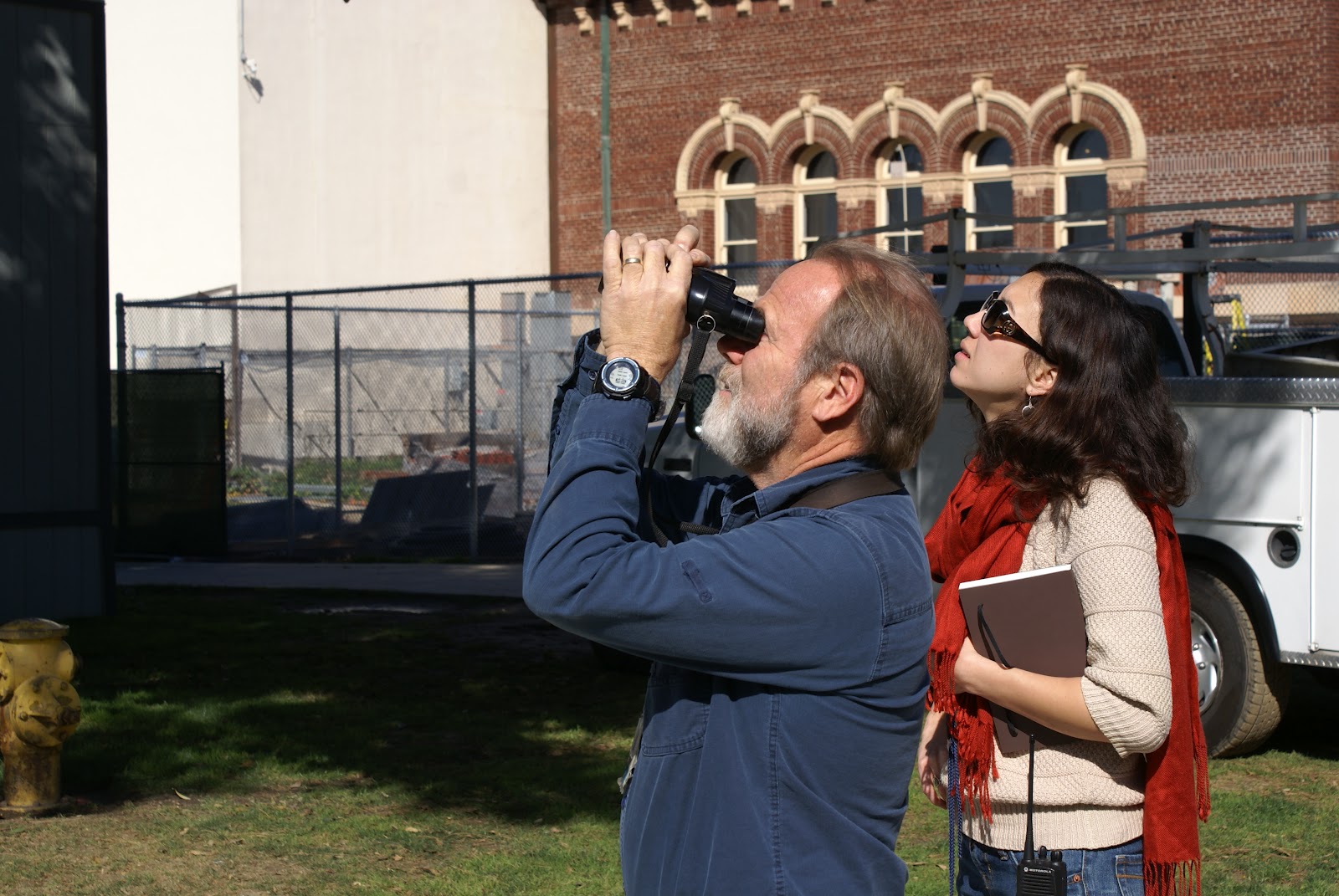
Kimball Garrett and Briana Burrows checking out the finches

Kimball Garrett is one diligent bird list maker!

Feeders and seed are generously donated to us by Wildbirds Unlimited in Torrance, CA

Friday, November 18, 2011

First Owl Recorded in North Campus


Yesterday ,we recorded the first owl in the North Campus. This adorable Burrowing Owl, Athene cunicularia, was observed perching on the footbridge surveying the patrons in the Museum Cafe. However, this is not the first time a Burrowing Owl has been recorded at the Museum. A few years ago, a Burrowing Owl actually roosted in a T. rex skull that was stored on our fourth floor patio. According to Kimball Garrett, the Museum's Ornithology Collections Manager, "these owls are migrants that are coming in from more northerly or interior breeding areas the breeding population in Los Angeles Basin is gone, or virtually so."  


Coincidentally, yesterday was also the date of Kimball's annual bird walk in Exposition Park. Between 8:10 and 9:45 am the group recorded 27 species of birds including the second ever record of a Wilson's Snipe, Gallinago delicata, for the park. Not that I registered that the brown blur flying away from me was a Snipe, let alone a bird, but I took Kimball's word for it!

Looking at American Goldfinches on the Museum Feeders
(photo courtesy of Brenda Rees)

Here's the entire list including numbers of individuals seen:
Merlin (Falco columbarius)  1
Wilson's Snipe (Gallinago delicata)  1
Western Gull (Larus occidentalis)  6
Rock Pigeon (Columba livia)  8
Mourning Dove (Zenaida macroura)  22
Yellow-chevroned Parakeet (Brotogeris chiriri)  4
Anna's Hummingbird (Calypte anna)  3
Allen's Hummingbird (Selasphorus sasin)  4
Nuttall's Woodpecker (Picoides nuttallii)  1
Black Phoebe (Sayornis nigricans)  5
American Crow (Corvus brachyrhynchos)  10
Common Raven (Corvus corax)  1
Bushtit (Psaltriparus minimus)  20 
Ruby-crowned Kinglet (Regulus calendula)  1
Western Bluebird (Sialia mexicana)  7
American Robin (Turdus migratorius)  6
Northern Mockingbird (Mimus polyglottos)  4
European Starling (Sturnus vulgaris)  8
Cedar Waxwing (Bombycilla cedrorum)  20
Orange-crowned Warbler (Oreothlypis celata)  1
Yellow-rumped Warbler (Audubon's) (Setophaga coronata auduboni)  20
Spotted Towhee (Pipilo maculatus)  1
Chipping Sparrow (Spizella passerina)  1
House Finch (Carpodacus mexicanus)  10
Lesser Goldfinch (Spinus psaltria)  1
American Goldfinch (Spinus tristis)  20
House Sparrow (Passer domesticus)  10

Other notable sightings:
Monarch Butterfly (Danaus plexippus) 2
Eastern Fox Squirrel (Sciurus niger) 5
Korean Air Airbus A380 1 (It seems Kimball is adept at identifying aircraft also!)


Thursday, September 29, 2011

Bird Crashes into Museum Building and Dies For Science

Soras, Porzana carolina, seem to be really poor fliers. So much so that last week one flew into the side of the Museum and killed itself. This brings the Exposition Park Bird List, maintained by Kimball Garrett, our Ornithology Collection Manager, up to 167 species. "But wait," I hear you crying, "what about bird number 166?" In my previous post New Bird For North Campus List, it clearly stated that the Rufous Hummingbird was species 165. No I didn't forget to tell you about bird 166, and no Kimball didn't miscount, funnily enough bird 166 was documented the same exact day the Sora died. Bird 166 is in fact a Swainson's Hawk, Buteo swainsoni, that Kimball saw migrating overhead.

Sora, Porzana carolina, ready to be prepped in the bird lab

Sora study skin after being prepped and accessioned into the collection

Soras are secretive yet fairly common birds in the rail family. They live most of their lives in the dense vegetation of freshwater or brackish marshes, and are usually thought to be reluctant flyers. However, in the spring and fall they take to the wing, some individuals migrating up to hundreds of miles. During these times they are often found after colliding with various built objects such as communication towers, wires, and buildings just like the one we found in the loading dock! 

Swainson's Hawk, Buteo swainsoni, surveying the land 
(note this is not the individual documented for our bird list)

As with Soras, Swainson's Hawks aren't very visible in the urban core of Los Angeles. However, they can easily be seen migrating along the foothills of the San Gabriel Mountains during their fall and spring migrations. The individual Kimball spotted over the Museum was on its way south to its overwintering site. Although we don't know where this individual will stop, we do know it will be somewhere between western Mexico and Argentina.


Thanks to Kimball for providing natural history information and pictures of the birds and also to Michael Wilson and Jerome Brown for finding the dead Sora!

Friday, May 6, 2011

Black Phoebes Build Nest

More Nest Surveillance

This week we found another active bird nest! This nest belongs to a pair of Black Phoebes, Sayornis nigricans, and is built under the eaves of the Rose Garden maintenance shed. Once again this find is thanks to Kimball Garrett, who noticed the nest Monday morning on one of his regular Expo Park bird surveys. 


 Footage of the phoebe landing on her nest


Naughty Neighbors

This is the second nest Kimball has found in this location this year, but it is a site that has been used by phoebes in past years. Unfortunately, this year's first nest was disturbed by unknown causes, but it is possible that a squirrel is to blame. Eastern Fox Squirrels, Sciurus niger, are very common in Expo Park, and they are known nest predators. When they locate a nest they will eat any eggs or young birds they find. We'll never know for sure if a squirrel is to blame for the first nests' failure, but fortunately the phoebes persevered and built a second nest.
Eastern Fox Squirrel on top of the Butterfly Pavilion

Better Luck This Time

Until today we were not sure if the new nest contained any eggs. This morning Kimball and I went out with a mirror and now we can confirm there are four eggs!

Kimball checks out the nest

The mirror reveals four eggs in the clutch

Now that we know there are eggs, we are going to regularly monitor the nest. I'll keep you posted as the eggs are incubated, they hatch and then the immature birds develop. If we are lucky, we'll be able to document the entire process.

Friday, April 29, 2011

Bushtits Move In

New Neighbors

A pair of Bushtits, Psaltriparus minimus, just built their nest in the live oak tree behind the Butterfly Pavilion. Kimball Garrett, our resident bird expert, found the nest this Monday and promptly sent me an e-mail detailing the nest's location. As soon as I got into work on Tuesday morning, I headed out to the Butterfly Pavilion to check it out.

Adult Bushtit, Psaltriparus minimus

Nest Hunt

Thankfully Kimball had given clear instructions to find the nest, as it was very well hidden in the oak foliage. The effort was well worth it, as it was one of the coolest nests I've ever seen in the wild. As the picture below shows their nests are woven from dry plant material and hang from branches of the tree. They are small and dainty, this one measures about seven inches from top to bottom. The small opening at the top of the nest, which is only about an inch in diameter, is just big enough for the adults to enter and exit.  

Bushtit entering nest

Bushtit Behavior

After spending a good portion of my morning watching the nest, I realized I had to blog about it. But what is a blog without images, or even better some actual video footage. I ran up to my colleague, Sam Easterson's office to see if he could get some for me. Sam recorded the nest for about an hour, and we captured some interesting behaviors, including removal of fecal sacs! A fecal sac is clean, tough membrane that encloses the excrement of young birds. Not all birds produce fecal sacs, but for those that do sacs are usually produced directly after each feeding and promplty removed by the adult to maintain a clean nest interior. 


Bushtit cleaning nest

Sam Easterson is a video naturalist and also our new Media Producer for the North Campus and Nature Lab exhibits. He's really into implanting cameras into natural environments, and is best known for his animal borne imaging work.