THIS BLOG HAS MOVED

This blog has moved it can be viewed here!

Thursday, February 23, 2012

First Clouded Sulphur Butterfly Pupa in North Campus

Last week, Jany Alvarez, one of the Museum's Guest Relations staff, was sitting at the bus stop adjacent to the North Campus. While she was waiting for her bus, she saw an interesting sighta caterpillar crawling along the sidewalk! Thinking that the caterpillar would be better off on a plant than on the cement, she picked the caterpillar up and placed it carefully on a Dudleya plant on the Living Wall.

Later that day, another Guest Relations staffer watched the caterpillar pupate! By the time word travelled to me, the pupa looked like this:

Yellow pupa on Dudleya

When I came into work on Tuesday morning, the pupa had changed color! I took more pictures and went back to my office to identify it.

Close up of pupa. Note the small horn-like structure

The pupa belongs to a butterfly regularly seen in and around Los Angeles, the Cloudless Sulphur, Phoebis sennae. The Cloudless Sulphur belongs to the Pieridae butterfly family, which includes White, Sulphur, and Orange-tip butterflies. The most common butterfly in this family is the Cabbage White, which flies year round in our area and is a pest on vegetables such as cabbage, kale, and broccoli. In contrast the caterpillar of the Cloudless Sulphur feeds on cassia plants (genus Senna) and is often seen in our local deserts where the two California native species in this genus grow naturally. The altered nature of Los Angeles is such that non-native cassias are now common all over our area. They've been planted in various places like your neighbor's backyard, your local park, and even in the North Campus. The bus stop where Jany found the Cloudless Sulphur caterpillar is only 20 feet away from a few feathery cassias, Senna artemisioides, which were recently planted in the North Campus!

I guess our premise for developing habitat around the Museum is correctplant it and they will come!
Male Cloudless Sulphur from our Entomology Collection


Friday, February 17, 2012

American Goldfinches Find Feeders and Get Counted

American Goldfinches, Spinus tristis, have found our bird feeders! Flocks of them have been visiting the nyger seed feeders that the Museum's live animal caretakers fill on an almost daily basis.

American Goldfinch (upper left) and
Lesser Goldfinch (lower right) feeding on nyger seed

Like most finches, American Goldfinches are primarily seed eaters, making them some of the most readily-attracted birds to feeding stations. They are fond of the small seeds of grasses and annual plants, especially a type of thistle seed called nyger. Within 24 hours of putting up our first nyger feeders, we recorded both American Goldfinches and the very closely related Lesser Goldfinch, Spinus psaltria. Of the two species, Americans are slightly larger and more numerous, but are usually only present in Exposition Park from October to April. Thanks to Museum ornithologist, Kimball Garrett's hard work (uploading his regular Exposition Park bird lists), you can explore the seasonality of birds around the Museum. Check out the seasonal abundance charts in eBird; you'll find the goldfinches at the very bottom of the chart.

In the spring when American Goldfinches leave the park, they often head over to nearby streambottoms to nest. Some do travel a bit further afield, heading all the way to northern California or beyond. In contrast the Lesser Goldfinches can be found hanging around the park year-round. We haven't yet documented any nesting here, but now we have planted the North Campus, we hope to observe some soon.

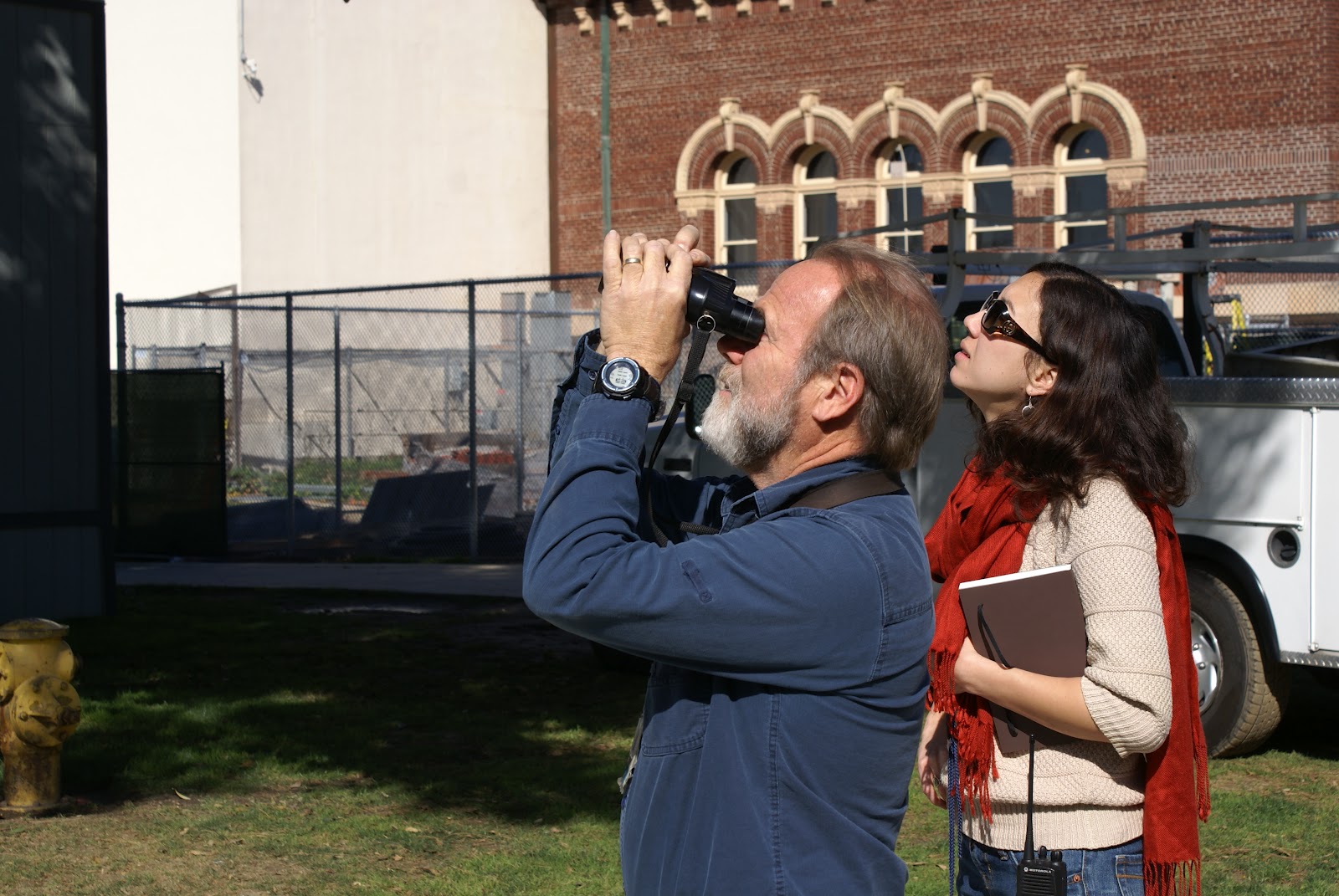
In an effort to record the birds at our feeders and in the newly planted areas of the North Campus, this year we are participating in the Great Backyard Bird Count (GBBC). So this morning at 10 am Kimball tromped around the Museum's grounds and counted all the birds he could find. This is what he recorded:

1 Western Gull                 
1 Rock Pigeon
1 Mourning Dove
3 Yellow-chevroned Parakeet
4 Allen's Hummingbird (one female nest building)
1 Northern (Red-shafted) Flicker
2 Black Phoebe
3 American Crow
10 Bushtit
6 Yellow-rumped (Audubon's) Warbler
20 House Finch
13 American Goldfinch
15 House Sparrow


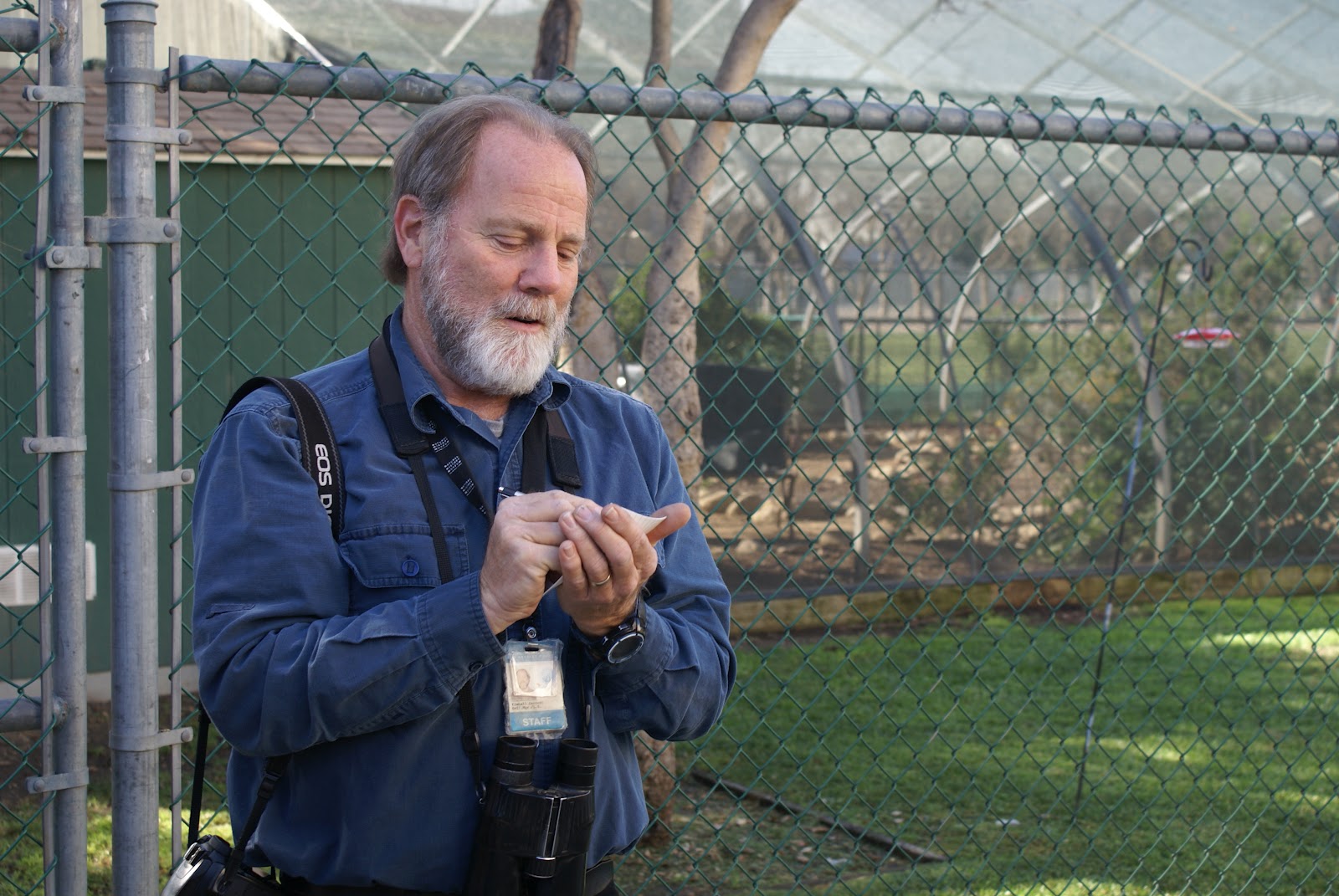
Kimball Garrett and Briana Burrows checking out the finches

Kimball Garrett is one diligent bird list maker!

Feeders and seed are generously donated to us by Wildbirds Unlimited in Torrance, CA

Friday, February 10, 2012

Blooming Agaves

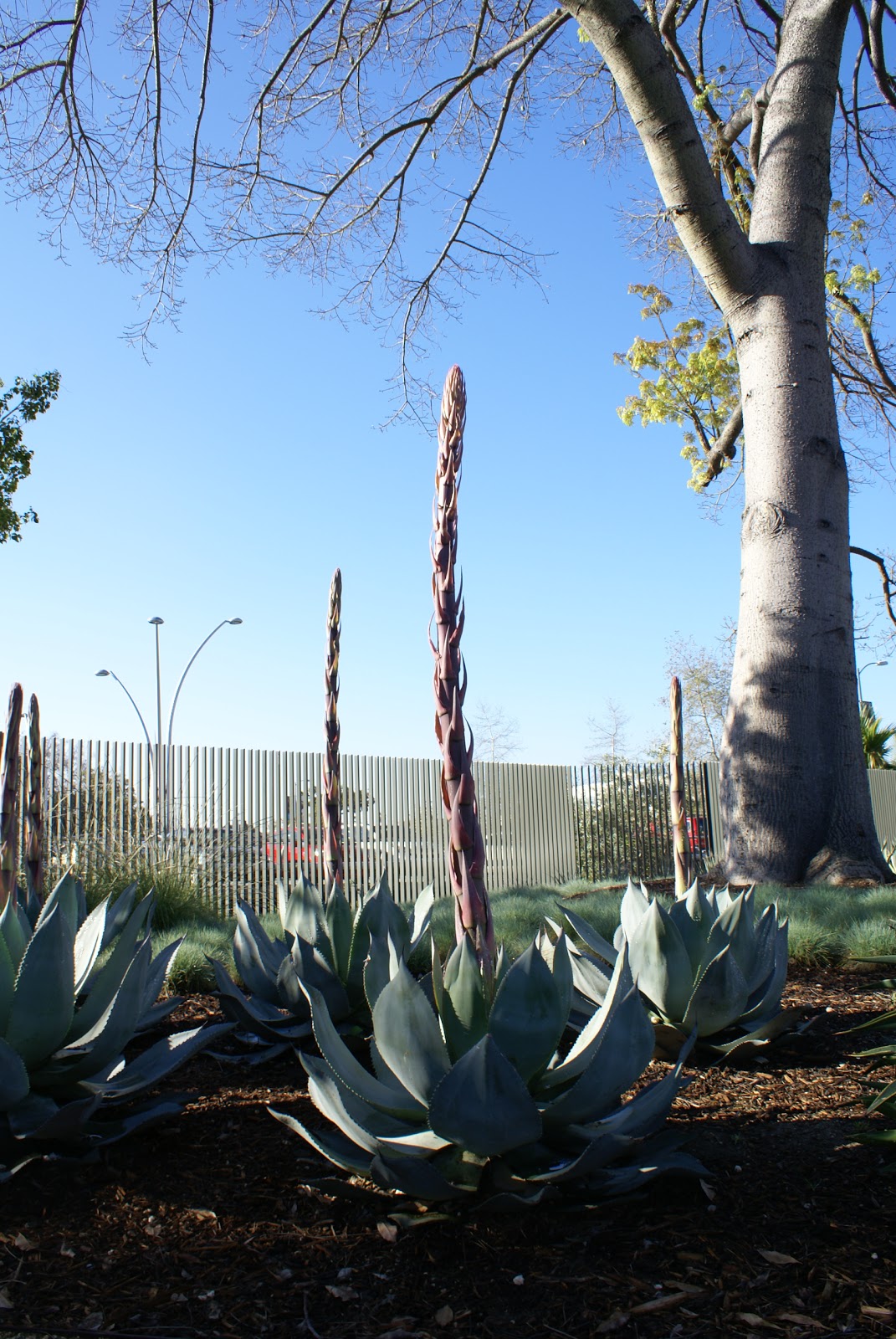
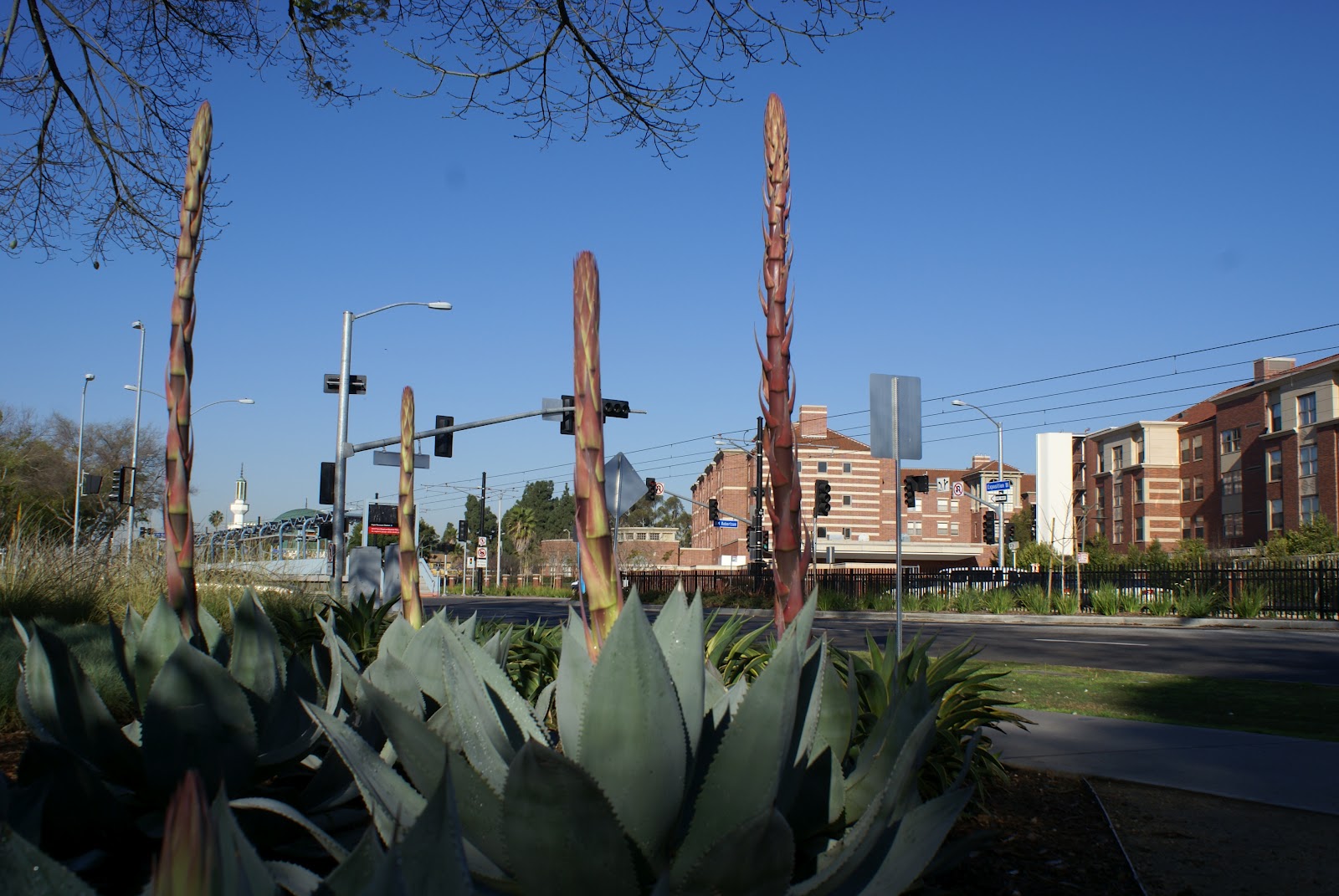
More plant news from the North Campus. Recently some of our blue lotus agaves, Agave ceslii 'Nova', have begun to bloom. This is an impressive sight as these plants send forth long spikes, (between four and six feet long), that look a lot like giant asparagus stalks. This type of agave is monocarpic, meaning that it only flowers once, and this particular selection happens to flower at a relatively young age compared to other species. Incidentally, the genus is commonly called century plant because it can take decades for them to flower. The entire stand of this agave (approximately eight plants) is flowering at the same time, because they were all propagated from the same tissue culture, which is a common nursery practice for certain landscape plants. Although flowering signals the end of the plant's lifespan, we can expect to enjoy the flowers and fruits for the next several months!

Agaves reaching up to the floss silk tree


There are over 300 species of agave in the world, with 100 species native to North America. This large array of species includes well known agaves such as the tequila or blue agave, Agave tequilana, and the sisal or hemp agave, A. sisalana. Other species are also farmed to produce agave nectar, which is sweeter than sugar and honey.

The blue lotus agaves we have planted are native to Mexico and are becoming more common in the nursery trade. As with all agaves, the flower stalks possess literally hundreds if not thousands of individual blossoms, which are visited by many kinds of pollinators. The flowers will be a pale yellow color and will hopefully attract the numerous Anna's and Allen's hummingbirds that are already resident in Exposition Park. Unlike other agave species, the ones planted on the North Campus will not attract mammalian nocturnal pollinators, aka bats, which is a shame since we will be very soon putting up a bat box (more on that to come later)!
Four stately stalks!

Stop by the North Campus and check them out today! They are close to the Dueling Dinos on the North side of the Car Pak along Exposition Boulevard.

Thursday, February 2, 2012

First Baby Oaks Sprout Up in the North Campus

The North Campus is the proud parent of some baby oak trees!

Baby coast live oak sheltered by wall

Carol Bornstein, our new Director of the North Campus Gardens, discovered a couple of oak saplings on one of her recent outdoor forays. The babies are coast live oaks, Quercus agrifolia, of which we recently planted several trees. We've also planted another species of oak, the Engelmann oak, Quercus engelmanni (we planted only three of this species). Both species reside in the section of the garden called the urban wilderness which is composed of several kinds of California native trees and shrubs.

This might be the mother oak!

Oak trees provide amazing habitat value, and this is the main reason we planted them. By putting in such a  sizable stand of oaks we're hoping our created wilderness will provide habitat for a whole slough of organisms rarely, if ever, seen before in Exposition Park. In just one oak tree it would be easy to find hundreds of species of associated plants and animals and thousands of individuals (think how many birds, ants, or squirrels you find in an oak tree). One species that has already shown up with our oaks, is a tiny insect called a whitefly.

Crown whitefly nymphs on oak leaf
(each nymph is only 1 millimeter long)

It was once again thanks to Carol, who was out inspecting our lovely oaks, that we discovered these small insects. At first we thought they might be a scale insect, but Brian Brown, the Museum's Curator of Entomology, identified them as crown whiteflies, Aleuroplatus coronata. As adults these small white homopterous insects (group of insects consisting of aphids, cicadas, scales, etc) fly around to find a suitable location to lay their eggs. For the crown whiteflies their plant of choice is oak. What you see in the image above are the nymphs (immature forms) of the whitefly, they have no wings but are covered with white waxy secretions that make them look like little crowns. The nymphs feed on the leaf's juices by piercing and inserting their mouthparts into the leaf. They can cause damage to the plant's health if their numbers are high enough, and they can also transmit disease organisms from one tree to another (not unlike mosquitos transmit malaria).

Go check out your local oaks and see what animals live on them!

Friday, January 27, 2012

Unusual Bird Sighting: Common Yellowthroat

Sam Easterson has caught a relatively unusual occurrence on camera. On New Year's day Sam's camera trap discovered a Common Yellowthroat (Geothlypis trichas) skulking behind one of our sheds (I should add that this is the same shed the opossums have a den underneath). It is relatively unusual only because of the season, this is only the third time a Common Yellowthroat has been sighted here in winter!

New Year's day sighting of female Common Yellowthroat

According to Kimball Garrett, our Ornithology Collections Manager, the Common Yellowthroat is a widespread North American wood-warbler, breeding in marshes and wet meadows and scrublands over most of the continent. In Exposition Park, Kimball usually observes yellowthroats in the Rose Garden, where the dense beds of roses provide good places to hide. Of course we hope that as the vegetation in the North Campus becomes established we'll begin to find them here too.

Same bird caught on camera 14 days later

All told Kimball has spotted the Common Yellowthroat 66 times in Exposition Park since he began surveying the area in 1984. Sixty-two of those sightings occurred during the bird's fall migration, between 27 August and 2 December. Kimball has also recorded two additional sightings during the bird's spring migration in April. Prior to this year's winter sighting, Kimball has observed the yellowthroat twice in mid-winter  on 27 January 2010 and 6 January 2011. This is why it was a bit of a surprise when Sam's camera trap recorded the visit of a female Common Yellowthroat earlier this month. According to Kimball, "modern technology is clearly better than an old human field ornithologist in keeping track of more secretive birds!" Regardless of the mode of sighting this record is good news. It suggests that the plantings in the North Campus will provide an important habitat that is lacking in the urban core. We are planting dense low vegetation that is the domain of wrens, Geothlypis warblers, various sparrows and other bird species that are rarely seen in your common urban park that is dominated by trees and lawns.

Thanks Kimball for your detailed bird records and natural history information of the Common Yellowthroat!

Friday, January 20, 2012

Aphid Eating Flower Fly Found in North Campus

There are over 150,000 species of flies in the world! Most visitors who come to the Museum can name only a few of these flies (house fly, horse fly, or mosquito for examples) and many hold the belief that we would be better off without flies in our world. On Wednesday, January 18, we found a fly that I am sure will help you realize that all flies can't be cast as "bad" characters I introduce the humble aphid eating flower fly, Eupeodes volucris.

Female Eupeodes volucris
Photo taken by Jerry Friedman

Why do people like these flies and not others? This isn't an easy question to answer, but I'll have a go... First of all, these flies eat aphids and as any gardener will tell you, aphids are a serious garden pest. Secondly, they belong to a family of flies known as flower flies so called for their proclivity to visit flowers and suck down nectar. Thereby they play a role in pollination. Finally, if you look closely at these small flies you'll see why a lot of geeky people, like myself, think they are quite beautiful. Not only are they brightly colored and highly patterned, when their eyes catch the sunlight just right they have an iridescent sheen! Although I might add that E. volucris isn't as flashy as its close relative, the aptly named stripe-eyed flower fly, Eristalinus taeniops, also a native to the Los Angeles area.

Stripe-eyed flower fly
Photo courtesy of What's That Bug website

How does a fly eat an aphid? It is actually the larval stage of the fly, or maggot that chows down on aphids. Much like immature ladybugs they trawl through a sea of aphids on a plant and chomp any that get in their way!  Though they don't have quite the same look as a ladybug! 

Flower fly maggots eating oleander aphids
Photo courtesy of What's That Bug website


To find out more our local flower flies, swing by the Museum gift shop to get a copy of our latest entomological publication, Flower Flies of Los Angeles County.

Flower Flies of Los Angeles County


Thanks to Brian Brown and Jim Hogue for supplying fly information and identifying the fly specimen.

Thursday, January 5, 2012

Walking Sticks Mysteriously Appear in Museum

Last Friday two Indian walking sticks, Carausius morosus, mysteriously showed up inside the Museum! They didn't escape from the Insect Zoo (we've never kept this species of walking stick before), and we haven't been able to find out exactly how they got here. What we do know is that the insects were discovered after a visitor felt one "fall" on his arm, and then promptly reported it to a staff person.


One of the Indian walking sticks found in the Museum!


Indian walking sticks, a.k.a. laboratory walking sticks, are one of the most common walking sticks around. They are often kept as pets and classroom teaching tools, and their eggs can even be purchased on eBay for fish food! Surprisingly these insects have recently established themselves in our area through inadvertent or purposeful introductions. How does one inadvertently introduce stick insects into the environment?

Indian walking sticks can reproduce parthenogenetically, that is without sexual reproduction. Therefore females can produce eggs regardless of the presence of males. The eggs are very small, about 3mm in length, and look a lot like tiny stones. Female sticks lay their eggs by dropping them directly to the ground, where they accumulate in the leaf litter. When they are in captivity, fecal material, partially chewed leaves, and eggs accumulate very quickly at the bottom of walking stick enclosures. To keep the insects clean and safe it is important for owners to clean this material out on a regular basis. For the untrained stick keeper, it is very easy to inadvertently discard eggs. Often this will be directly into the trash, or maybe even into the backyard compost pile. Paired with purposeful introductions, "I can't keep this pet anymore, I'm sure it will be better outside," is it any wonder that these insects have established themselves in numerous areas around Los Angeles?

Indian walking stick eggs
(photo courtesy of Dr. Arakelian)

According to Dr. Gevorak Arakelian, Senior Biologist in the L.A. County Department of Agricultural Commissioner, Indian walking sticks have recently been downgraded from a B rating to a C rating. This means that they aren't viewed as serious pests that need to be eradicated. However, for gardeners and the nursery industry these insects can still be troublesome. They eat a wide variety of landscape plants including rose, bramble, camelia, hibiscus, geranium, oak, and English ivy (the list goes on). Next time you find mysterious chew marks on your rose bush, take a closer look and see if you can find a walking stick hiding nearby.

For more information check out Dr. Arakelian's Indian walking stick fact sheet.